Monday, 24 August 2020

Zyxomma obtusum 2


Anisoptera

Species name: Zyxomma obtusum

Family: Libellulidae  

Mature males of this crepuscular species are entirely covered with white bloom which gives it a ghostly appearence when silently flitting over drains at dusk or early dawn.
 
A male in flight. See another male in flight here


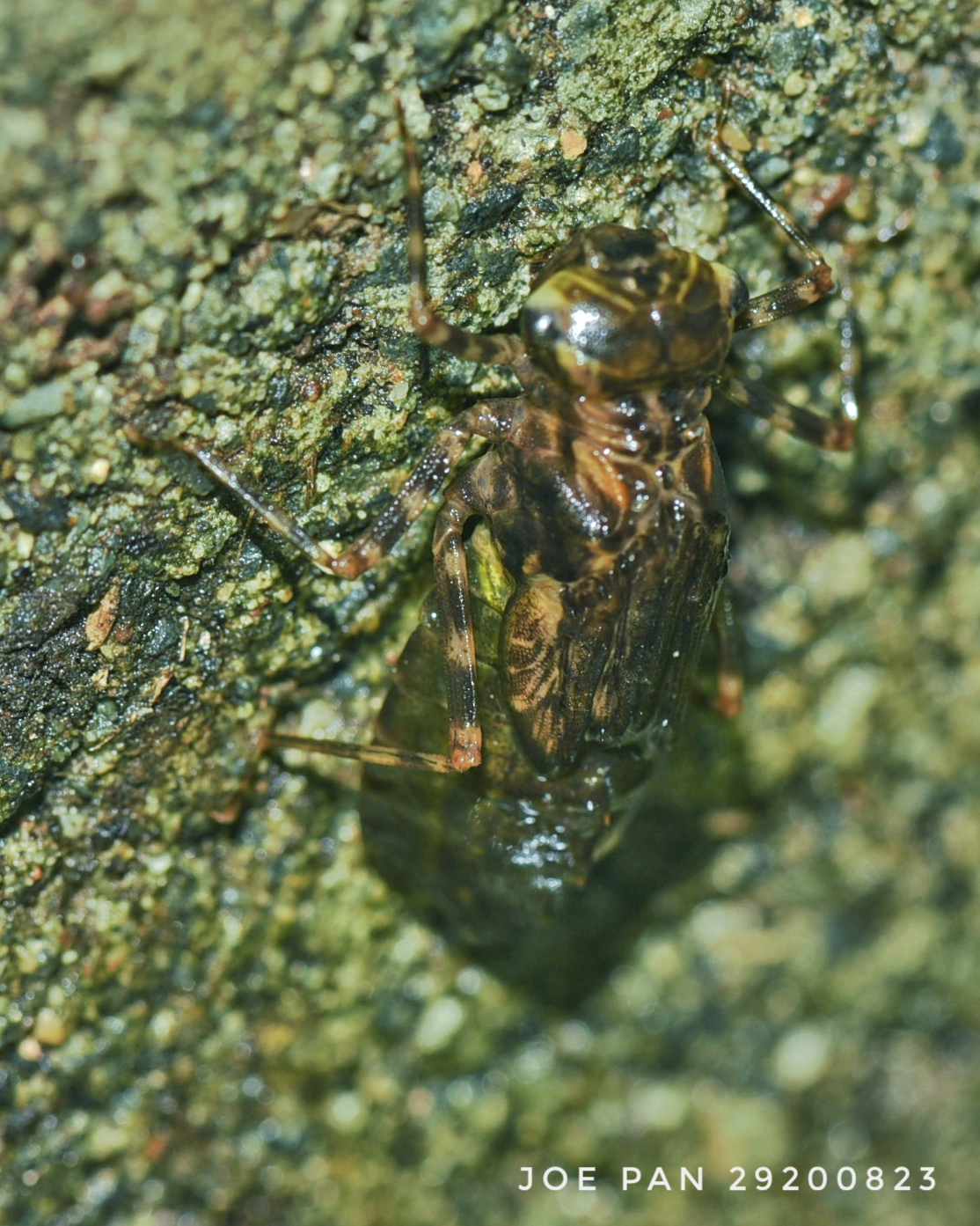
I recently found some larvae living in a cement water tank, no doubt feeding on tadpoles of the four-lined tree frog and other aquatic life in the water.

A final instar nymph.

A nymph that has crawled out of the water and 
ready to emerge.

The newly emerged imago beside its exuvia in the process of drying its wings.
 It is a male (teneral) still lacking its full mature colour. 

Friday, 7 April 2017

Sieboldius japponicus


Anisoptera


Species name: Sieboldius japponicus

Family: Gomphidae

The first time I saw this species was on a boat ride on a clear rocky forest stream in Long Pasia, Sabah in September, 2016. To my astonishment one flew past our boat as my friend Shauming Lo and I were just beginning to take in the beauty of the surroundings. It was large and flew quite audibly and was like nothing we had seen before. Shauming promptly nicknamed it The Helicopter! We quickly scrambled to take photos of it when it perched on the side of the boat, but when we met more and more along the way we took our time and were able to take some photos of them on rocks and wood in the river.


With a hindwind length of 55mm in males and up to 57mm in females it is the largest of Borneo's gomphids. Its colour and rather small-headed appearance also make it easy to recognise.

Though its name "japponicus" may seems to indicate that it is also found in Japan it in fact is only present in Borneo, Sumatra, Malaya and southern Thailand. It was named in 1854 on the mistaken belief of the author that the specimen was collected in Japan!

Tuesday, 4 April 2017

Brachygonia oculata


Anisoptera

Species name: Brachygonia oculata

Family: Libellulidae


Even though described as widespread and common in its range I only recently encountered this dainty species in the Sama Jaya Nature Reserve in Kuching, Sarawak after years of semi-serious dragonfly chasing! The males (I did not see any females) were gathered in quite large numbers in the swampy area of the park and were quite conspicuous in their attractive powder-blue and orange "attire". After I saw the first one it was very easy to see one everywhere I looked along the forest paths!

The species' range is Sundaland (except Java) up to Indochina. 


Tuesday, 4 March 2014

Rhodothemis rufa

Anisoptera

Species name: Rhodothemis rufa

Family:   Libellulidae


My last post on this species was in December 2009 featuring a newly emerged female. Male R. rufa is not easy to distinguish from other medium-sized red species of libellulid like Orthetrum testaceum, Crocothemis servilia or Urothemis signata. The female however is easier to recognise with her brownish colour and a middorsal pale yellowish streak.

I have recently photographed both males and females in the field.


Male
Female

Tuesday, 1 January 2013

Pantala flavescens - Emergence


Anisoptera

Species Name: Pantala flavescens

Family: Libellulidae

Without realizing it two long years had passed since my last post! My first post for the new year 2013 is only my second "emergence" post - of arguably, the most common dragonfly in the world.


In December 2012 I was lucky to find a few nymphs in a water tank and one night literally stumbled on an emergence in progress.


Sunday, 12 December 2010

Trithemis aurora


Anisoptera
Species name: Trithemis aurora
Family: Libellulidae

A whole year has passed since I last posted in this blog! I just can't believe how time passes so fast! Well, at least I still have one post in 2010. Hopefully more...

Male in all its splendour
Female

The Crimson Dropwing is a common dragonfly of open ponds and drains. The male is brightly coloured - its whole body as well as the viens on its wings are bright pinkish crimson. Quite a sexy guy, who likes to show off his colours basking in the sun while assuming the obelisk posture! The female however is comparatively dull - she's light brownish.
Male in obelisk posture

Female doing handstand! What he can do so can she!

This is a widespread species with a geographic range that cover the whole of Asia.

Sunday, 20 December 2009

Rhodothemis rufa

Anisoptera

Species Name: Rhodothemis rufa

Family: Libellulidae


For the first time I was able to rear a dragonfly larva up to emergence. However unfortunately although I guessed the day of emergence, I was too late to catch the start of the emergence process.On the morning of the larva's change to adulthood I woke up at 3:15 a.m. but found that it had already fully emerged! I was only able to take photos of it hanging fully extended from the exuvia.

This, after 2 months of guessing and wondering about its species, turned out to be Rhodothemis rufa a common species in Asia - with a range from Bangladesh through India, Indochina, China, Malaysia, Indonesia and the Philippines. My thanks to Dr Rory Dow and Dr Sadayuki Ugai for the sp. identification.

The male however is rather difficult to distinguish from other common and very similar red libellulids. However the female (shown here) is recognized by its brownish colour and the mid-dorsal light yellow streak which run from the top of the antefrons through the thorax down to segment 5 of the abdomen. Unfortunately I don't have a photo of a male.

The larva when I first collected it was a rather long-legged spiderlike creature!

Mature larva (underside)


Mature larva with mosquito larvae which I provided it. It also readily ate small tadpoles.


The newly emerged female with its characteristic mid-dorsal line.

Sunday, 14 June 2009

Indaeschna grubaueri

Anisoptera
Species Name: Indaeschna grubaueri
Family: Aeshnidae
Male resting beside pond
Members of the family Aeshnidae are the gaints of the Odonata and this is one of the largest of the gaints. This is the second time that I've seen and photographed this species at the very same pond at the edge of a forest reserve near Lahad Datu town. The first time was in 2006 when I saw a male resting on vegetation at the side of the pond, and today I was fortunate enough to see this huge female ovipositing at this pond. Interestingly she was laying her eggs in the moist soil just above the water. This species is also known to lay its eggs in water-filled tree holes and on buttress cavities of large trees.
Female on the wing
Females of I. grubaueri have hindwings that measure up to 68mm while males are thinner and smaller with 59-62mm long hindwings. Both sexes are similarly coloured with bright lime-green markings on the thorax and wide bands on the abdomen.

Female ovipositing on wet soil above water line

This species is said to be widespread in lowland forest in Sundaland and the Philippines.

Sunday, 7 June 2009

Libellago hyalina

Zygoptera
Species Name: Libellago hyalina
Family: Chlorocyphidae
This is the other Libellago sp. which I was able to photograph with my Nokia mobile phone in the Binusan Forest Reserve in Nunukan, Kalimantan Timur, Indonesia during my short visit there last week. Dr Rory Dow said my photos "almost certainly" showed Libellago hyalina.
L. hyalina has a wider range than the sp. in my previous post, being found from parts of China, Thailand, down to Peninsular Malaysia, Borneo and other parts of Indonesia.

My photos show the mature male which has a dark blue/purple abdomen (apparent only when seen in bright sunlight). Immature males have red markings on the abdomen, while the females like those of other spp. in this genus are rather darb in colour.

Libellago phaethon

Zygoptera
Species Name: Libellago phaethon
Family: Chlorocyphidae
Last week I took the short ferry ride from Tawau, Sabah across the border to Nunukan in East Kalimantan, Indonesia. There, friends took me to a picnic area in a forest reserve near town but unfortunately I had not brought along my DSLR camera, because I found some very interesting damselfly species which were new to me! Two of them were Libellago spp. of which, after much patience, I was able to take some fairly sharp photos with my Nokia N85 mobile phone camera!


L. phaethon is said to be known only from northeast Borneo (just south of Tawau, Nunukan Island would be in this area) being more well known from small streams in Danum in Sabah.
The male is uniquely coloured blue (on thorax and basal half of abdomen) and red markings on the rest of the abdomen. The female (which I did not see) like those of the other species in the genus is darb in colour and difficult to identify unless when associated with the males.

I observed typical Libellago male agression behaviour among the males - two males would hover above a piece of territory facing each other until one of them retreats. I also saw this species confront males of L. hyalina  which was also quite common here in this manner.

Saturday, 9 May 2009

Tholymis tillarga

Anisoptera
Species name: Tholymis tillarga
Family: Libellulidae
A male resting in the shade during the day photographed 
on Pulau Sapi an island off Kota Kinabalu  

This is another common crepuscular libellulid like the two Zyxomma ssp. (obtusum & petiolatum) and are found in similar habitats, i.e. drains, weedy ponds and other open bodies of water. 
Two males in flight at dusk

It is active at dusk, flying to and fro along drains and across ponds, the males are quite conspicuous for the white wing patches. In flight they are rather frustrating to photograph! 
An immature male showing very faint white wing patch

A female

The body of this medium-sized insect is orange-brown and the hindwing has an amber tinted patch followed by a patch of bluish white in the males while this white patch is absent in the female. Hence its common name - Coral-tailed Cloudwing.

Distribution: widespread in tropical Asia, Africa and Australasia.

Sunday, 3 May 2009

Drepanosticta versicolor

Zygoptera
Species Name: Drepanosticta versicolor
Family: Platystictidae


Members of this family of small damselflies are dwellers of primary dipterocarp forest and found on small streamlets and boggy areas around springs. Drepanosticta spp are brownish bronze in colour, usually with abdomens marked sparingly with light blue or pale spots and they fly close to the ground in the shaded  forest understorey making them very difficult to see. I only saw this specimen for a few moments before it vanished back into the shadows!

Bornean platystictids are still not well studied and many more new species are likely to be found. However the insect in my photos is quite likely to be D. versicolor by virtue of the presence of a long sharp spine on the rear margin of its prothorax. (I thank Dr Rory Dow for identifying these, and other photos for me).

I took these photos on a recent visit to the Danum Valley Field Centre whose many jungle trails and streams proved to be ideal hunting grounds for me! Alas two days was simply too short!

Saturday, 2 May 2009

Coeliccia nigrohamata

Zygoptera

Species Name: Coeliccia nigrohamata

Family: Platynemididae


I found several males of these small damselflies with conspicious blue markings on the upperside of the thorax resting on low vegetation along a small streamlet on the forest edge in the Danum Valley Field Centre. Unlike most damselflies they were extremely unafraid and I could easily pick them up with my hand. (Unfortunately I did not see any females).

On checking Dr A G Orr's Dragonflies of Borneo later I found my photos matched that of Coeliccia nigrohamata. I was however informed that members in this group of Coeliccia were currently under reclassification and this could very well be classified as a different species! 
Coeliccia spp. are found in forested habitats, inhabiting fresh water marshes, streams and springs. They are not usually found in open country or big rivers. This particular species belongs to a group of blue-marked species in the genus, another group consists of mainly species with yellow markings. A species found in Peninsular Malaysia, C. octogesima has a famous blue telephone-shaped logo on the synthorax (see Dr Choong's blog).

Coeliccia nigrohamata  has been recorded from Brunei and Sabah.

Saturday, 25 April 2009

Neurobasis longipes

Zygoptera
Species Name: Neurobasis longipes
Family: Calopterygidae

Male on rock in midstream (taken without flash)
This  surely has to be the most beautiful damselfly in Borneo! Witnessing it in nature is one of the most breathtaking experiences for me. My photos hardly convey the true beauty of this creature that has simply to be seen in life.  I had previously only glimpsed it momentarily on a few ocassions in forested rivers and had never had a chance to photograph it until now. 

Close-up of male (taken with flash)
I saw this spectacular male in the shallow rocky Sungai Palum Tambun which is a tributary of the mighty Segama River in the Danum Valley Field Centre. It was tirelessly flitting from rock to rock in the late afternoon, occassionally I also saw his less colourful mate, but she was too shy to pause and pose for me! It had me chasing it from rock to rock trying to get a good picture and mercifully, just as I was about to become totally exhausted and before the sun disappeared, it stayed put for a while and let me approach it to get my photo!

The body of both sexes are bright metallic green in colour, the top of the male's hindwings are brilliantly iridescent  green and its forewings are clear with a yellow-brown tint while the both the female's wings are clear with a lighter yellow-brown tint.

Members of the family Calopterygidae (from the Greek words meaning beautiful wings) are slender with long thin legs and mainly coloured metallic green. N. longipes is found in Borneo as well as in Peninsular Malaysia where another similar and slightly bigger species N. chinensis is also found. 

Sunday, 12 April 2009

Orchithemis pulcherrima

Anisoptera
Species Name: Orchithemis pulcherrima
Family: Libellulidae
I was pleasantly surprised when I came across this small dragonfly near a pond in the oil palm plantation recently as I have never seen it in Sabah before. I first saw and photographed this species in the Lambir Hills National Park in Miri, Sarawak in 2006.
This species is rather interesting because of its many colour forms or morphs. At least four distinct colour forms are known - orange, red, blue and a dark almost black form with a white band on its abdomen. 
This male, like the one I saw in Miri is of the orange variety.

The geographical range of this libellulid is recorded as Vietnam, Thailand, Peninsular Malaysia and Singapore, Borneo, Indonesia and the Philippines.

Sunday, 15 March 2009

Raphismia bispina

Anisoptera
Species Name: Raphismia bispina
Family: Libellulidae

Female

Last week on a short visit to the Borneo Paradise Eco-resort near Lahad Datu, Sabah I saw and photographed a small female libellulid on the mangrove edge which I had never seen before. When Rory Dow saw the photo which I emailed to him he said it looked like the female of Raphismia bispina a mangrove specialist. On checking the books and on the Net I found out that the male is a small blue fellow that resembles Brachydiplax chalybea, and I suddenly recalled seeing what I thought was a very skittish B. chalybea at the same place.

Male guarding a pond

Well, today I went to look for this male and found quite a few of them in the mangrove forest at the resort. Almost every small tidal pond (of salt water) has at least one male guarding it. And I also saw a female ovispositing in one of the ponds jealously guarded by the resident male.

Male perched on mangrove seedling

At first glance the males look like B. chalybea except that they are a bit smaller and the shade of blue is slightly different. But unlike the latter they are very skittish flying away at the slightest movement and landing further away. It took me quite some time and very patient stalking to get my first satisfactory shot.

I also tried to take some photos of their underside (upskirt photos!!) to try to show the signatory twin spines on their thorax behind the hind legs and the process projecting beneath on segment 2 of the abdomen. See if you can spot these on the photos.

Male, the process on abdominal segment 2 is clearly 
visible, but the pair of spines behind legs are less so